.png)
Community-Based Care in Texas and SSCC’s Role
- Jul 17
- 5 min read
Updated: Jul 27
How Texas Community-Based Care Works and What It Means for Your Foster Care Organization
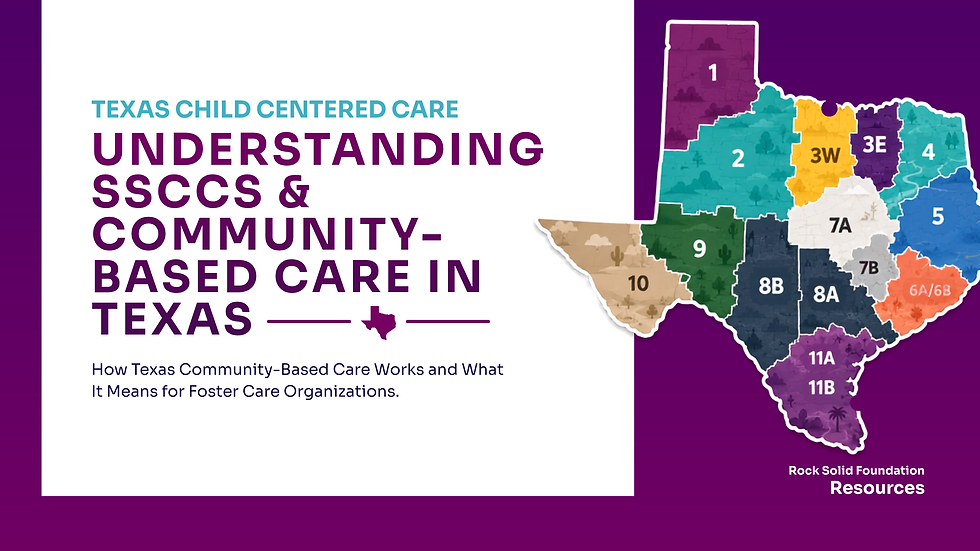
Table of Contents
What Is Community-Based Care (CBC)?
If you are just diving into Texas Foster Care, and working to build your Foster Care Organization, one of the first things you will encounter is Community Based Care, or CBC. Community Based Care is Texas’ regional approach to foster care. Its goal is to improve outcomes for children and families by allowing communities to help care for their own children. By coordinating foster care services regionally, CBC is designed to keep children as close as safely possible to their families of origin, schools, support systems, and home communities.
In each CBC region, a Single Source Continuum Contractor, or SSCC, is responsible for developing and managing the local network of foster care providers and services. The SSCC works with organizations throughout the region to support placement stability, coordinate care, and help ensure children and families receive services that reflect the needs and resources of their community.
If you are planning to start, expand, or strengthen a foster care organization in Texas, understanding CBC and the role of your regional SSCC is essential. Your organization’s location, programs, and services can affect which SSCC you work with and what contracting opportunities may be available. Before pursuing licensing or expanding services, it is important to understand both the needs of your region and the role your organization could play in helping the community care for its children.
What Is an SSCC?
An SSCC (Single Source Continuum Contractor) is the lead organization responsible for coordinating foster care services within a designated Texas Community-Based Care region. Think of the SSCC as the organization responsible for building and managing the regional foster care network.
Each SSCC works closely with the Texas Department of Family and Protective Services (DFPS) . They contract with DFPS to manage designated foster care services within a specific Community Based Care region. DFPS maintains oversight and responsibility for child safety, while the SSCC coordinates the regional network of placements, services, and supports needed by children and families among local providers including:
Child Placing Agencies (CPAs)
General Residential Operations (GROs)
Residential Treatment Centers (RTCs)
Therapeutic providers
Community partners
Most SSCCs build networks of qualified organizations that work together to meet the needs of children and families. In simple terms, the SSCC coordinates the regional foster care system while providers deliver the services.
How Does Community-Based Care Work in Texas?
Community-Based Care operates through regional partnerships.
Each SSCC is responsible for:
Building provider networks
Coordinating foster care placements
Monitoring service capacity
Identifying gaps in care
Supporting permanency planning
Working with DFPS throughout the region
As Community-Based Care expands through implementation stages, additional responsibilities may include case management, kinship services, reunification services, and long-term performance accountability.
How Are Texas Foster Care Regions Structured?

Texas is divided into multiple Community-Based Care regions, each managed by its own SSCC or lead entity.
Every region differs based on factors such as:
Population
Number of children entering care
Available foster homes
Existing provider capacity
Specialized treatment needs
Geographic challenges
Some regions may urgently need therapeutic foster homes. Others may need residential treatment services. Still others may need additional Child Placing Agencies or specialized behavioral health providers. Because every region is unique, as you are building your organization, you should evaluate regional demand before investing significant time and resources into expansion. DFPS maintains current Community-Based Care regions, implementation stages, and SSCC assignments on its Community Areas webpage.
Why Understanding Your Region Creates Opportunity
So let's talk more in depth about why understanding your region is important. First of all, each region has its own children, families, service gaps, existing provider network, and priorities. Taking time to learn about these factors can help your organization:
Identify where additional capacity is needed
Develop services that complement existing programs
Align with the SSCC’s current priorities
Respond to changing needs within the community
Build stronger regional partnerships
Organizations that thoughtfully align their programs with identified regional needs are often better positioned to receive referrals, develop lasting partnerships, and grow sustainably. Success in Texas foster care begins with a quality program that is designed to meet the needs of the children, families, and communities it serves. A few things for you to keep in mind as you assess each region:
Assess Every Region's Differences
Every SSCC manages its provider network uniquely. Contracting processes, priorities, referral patterns, and service gaps vary from region to region, from SSCC to SSCC. Understanding these differences and needs can significantly improve the long-term success of your organization.
Build with Regional Insight
Strong programs begin with a clear understanding of the community they will serve. Before investing in staffing, facilities, or licensing, organizations can strengthen their planning by researching details about the community they serve, including:
Current service gaps
Population trends
Referral patterns
Existing provider capacity
This insight helps organizations make informed decisions and develop services that respond to genuine regional needs.
Continually Align the Services You Offer with the Regional Needs
Quality organizations are best positioned for success when their services align with the SSCC’s current priorities and the needs of children and families in the region. Successful providers don't just implement the community research into thier organization, they also regularly evaluate regional trends, communicate with local partners, and adapt their services as needs change. This continued alignment helps organizations address meaningful challenges, build stronger SSCC partnerships, and create a lasting impact within their communities.
How Rock Solid Foundation Helps Organizations Navigate SSCCs and Community Based Care
Rock Solid Foundation partners with foster care organizations throughout Texas to help them make informed strategic decisions before investing significant time and resources.
Our team helps organizations:
Understand SSCC expectations
Analyze regional service demand
Prepare for SSCC contracting opportunities
Build sustainable provider strategies
Align programs with Community-Based Care priorities
Develop operational systems that support long-term growth
Evaluate the best Texas foster care regions for expansion
Whether you're launching a new Child Placing Agency, expanding a Residential Treatment Center, opening a General Residential Operation, or strengthening an existing organization, strategic planning can help reduce costly missteps and improve long-term success.
If you're evaluating your next step, we're here to help.

Frequently Asked Questions
How does Community-Based Care work in Texas foster care?
Community-Based Care transfers many foster care responsibilities from the state to regional organizations.
What is an SSCC in Texas foster care?
An SSCC (Single Source Continuum Contractor) is the organization responsible for coordinating foster care services within a designated Community-Based Care region in Texas. The SSCC manages provider networks, coordinates placements, and works to ensure children receive appropriate services.
How are foster care placements assigned in Texas?
Placement decisions are coordinated by the SSCC in regions operating under Community Based Care and by DFPS in regions that have not yet transitioned to CBC. Children are matched with providers based on their assessed needs, the provider’s approved T3C Service Delivery Package credentials, available placement capacity, proximity to the child’s family and community of origin, and other factors affecting the child’s safety and well being.


Comments